Coastal salt spray, sandy marl soils, and persistent 80% humidity in Hallandale Beach accelerate pest outbreaks on exterior vegetation. In neighborhoods like Golden Isles and Three Islands, canal-front humidity…
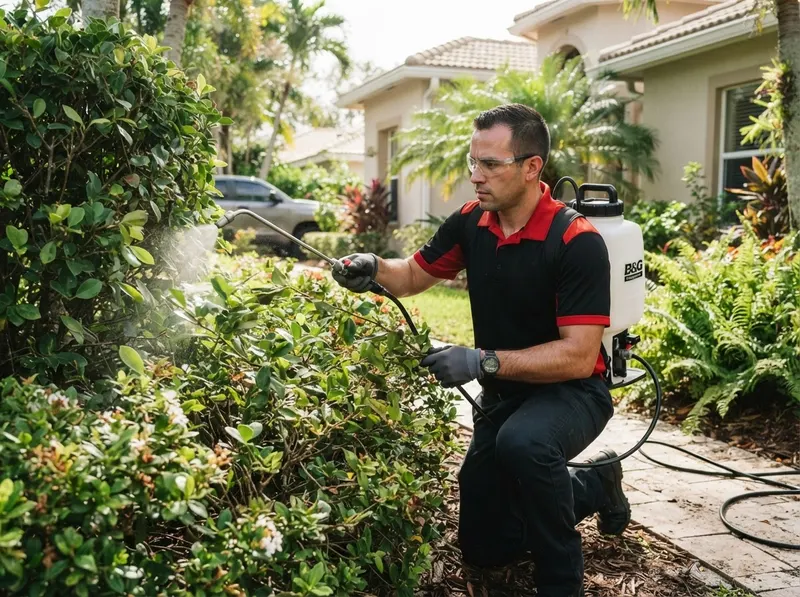
Coastal salt spray, sandy marl soils, and persistent 80% humidity in Hallandale Beach accelerate pest outbreaks on exterior vegetation. In neighborhoods like Golden Isles and Three Islands, canal-front humidity incubates rugose spiraling whiteflies (*Aleurodicus rugioperculatus*) and croton scale, which coat decorative arecas and gumbo limbos in sticky honeydew. Passive nursery fertilizers fail to solve these infestations because sap-feeding insects drain vascular fluids before nutrients reach the leaf tissue. Treatment requires targeted systemic active ingredients introduced directly into the root zone or lower vascular bark, halting infestation cycles at the cellular level without spraying wide-spectrum toxins into nearby marine waterways.
Properties bordering the Diplomat Golf & Tennis Club area and along the South Ocean Drive corridor deal with distinct stress patterns. High winds deposit salt crusts onto buttonwood and sea grape leaves, masking early signs of fungal leaf spots like *Cercospora* until defoliation is already underway. Inland lots in Foster Park, Hallandale Heights, and Chula Vista face severe ficus whitefly defoliation along boundary hedges that screen shared property lines. Standard consumer sprays wash away in South Florida's afternoon convective downpours; professional tree and shrub care binds systemic chemistry into plant vascular systems, providing up to 90 days of internal protection that rain cannot degrade.
Selecting a targeted tree shrub protocol comes down to botanical reality: foliar contact sprays clear surface infestations immediately, while root drench systemic applications protect subsequent flushes of growth over three to six months. If a hedge exhibits thick black sooty mold, the primary target is not the mold itself, but the sucking insects feeding on the undersides of the leaves above it. The practical trade-off centers on treatment frequency versus intervention speed: rapid surface sprays require follow-ups every 30 days during peak summer heat, whereas subsurface systemic root injections carry higher upfront costs but cut service frequency down to two to four times per year.
Every job gets a firm, written price after a free on-site visit.
Tell us about your tree shrub care job in Hallandale Beach and we'll send a clear, written quote, usually the same day.
 Red Rooster Pest Control